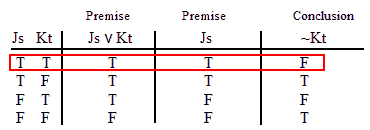
PROOFS A "proof" is anything that purports to show that something is true. (The pictures in the previous chapter are considered proofs. The first and third ones are bad because they fail to prove anything about their respective arguments, the ones that show a false conclusion with all true premises are good because they succeed in proving that those arguments are invalid.) But pictures can't prove an argument valid, (try drawing a picture that proves that you can't draw a picture), so we still need a way to prove arguments valid. In this chapter, you will learn how to set up a truth table for an argument, and use that truth table to tell whether or not the argument is valid. The basic idea for this is to see whether or not the truth table contains any rows in which all the premises are true and the conclusion is false. Once you have had some practice with truth tables, you may very well be able to do this just by looking at the truth table. However, most people cannot do this right away, so I'm going to teach you an easier method. This method, the method of "row-elimination," is actually more work than the "just-look-at-the-table" method, but it proceeds by a series of small steps, each of which is fairly easy in itself, that eventually change the truth table into a form in which you will easily be able to see whether or not the argument is valid. Basically, you will eliminate any row in which any premise is false, and you will eliminate any row in which the conclusion is true. If there is a row that cannot be eliminated by either of these rules, it will be a row in which the premises are all true and the conclusion is false, and so it will be a row in which the argument is invalid. If those two rules allow you to eliminate all the rows, then there will be no row in which the premises are true and the conclusion is false, and so the argument will be valid. Yes, I know that that sounds complicated. Don't worry, I'm going to spend the whole rest of this lesson explaining and illustrating the meaning of this paragraph. The bottom line is, at the end of this lesson you should be able to use truth tables to determine the validity of arguments, at least for simple arguments. It's okay if you have no idea how to do that now, it will all be clear by the end of the lesson. DETERMINING VALIDITY BY TRUTH TABLE To use a truth table to discover whether or not an argument is valid, you fill out a truth table for the argument, with premises and conclusion marked, and see if there are any rows in which the premises are all true, and the conclusion is false. If you find one or more rows like that, the argument is invalid. If there are no such rows, the argument is valid. |
|
| I'm confused! |
Remember an argument is only invalid if it's possible for it to have all true premises and a false conclusion. If you can find a true-premises/false conclusion row in the table, the argument is invalid. And if you can't find a true-premises/false conclusion row, the argument has got to be valid. | That didn't help. grrrrrrrrrrr. |
![]() |
![]() |
![]() |
|
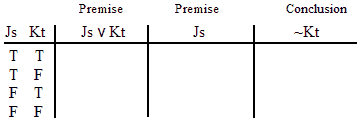
Here's an argument Js v Kt Js ~Kt And here's how the truth table starts out: ![]() Notice that each basic term gets its own column to the left of the double line. Premises and conclusion are marked as such, and each premise gets it's own column, even if it's just one of the terms. |
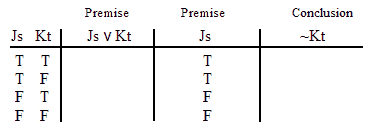
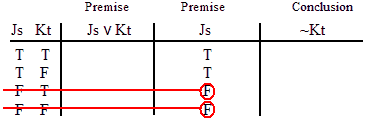
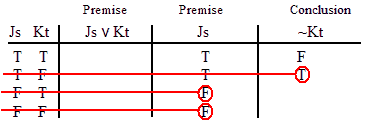
"Js" is both a basic term and a premise, so its premise column is easy to fill out. Like so: ![]() Now look at the third row down, where Js = F. Is it possible for this row to be the kind of row were looking for? Remember that we're looking for rows where all the premises are true and the conclusion's false. Can all the premises be true on row number 3? |
|
|||||||
|
|||||||
|
So, an "F" under a premise lets me eliminate a row. |
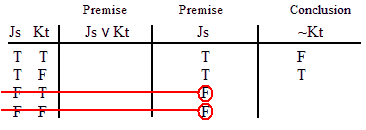
And "T" under the conclusion also lets me eliminate a row. |
But a "F"
under
the conclusion does not let me eliminate a row |
And a "T"
under a premise does not let me eliminate any row. |
![]() |
![]() |
![]() |
![]() |
![]() |
Now, test your knowledge by taking a quiz! |
![]() |
And when you're done, we'll go on with the example |
Fill in the value
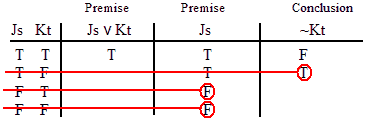
of "Js v Kt" on the only row we have left. That value is "T" |
![]() |
![]() |
||
![]() |
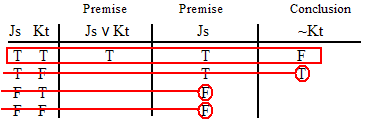
It's not a "T" under the conclusion ^^ or an "F" under a premise, so row one can't be eliminated. |
In fact, row one has all true premises and a false conclusion! So the argument is invalid, |
![]() |
And we draw a box around that row to make it clear that it's invalid. |
|

Well. I guess you could do it that way. It might even be quicker. |
||
|
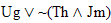
![]() |

Here's
an argument Mg Dr v Mg |

Try to do this one on your own |

If you can't figure it out, here's a power point presentation |
||||
![]() |
![]() |
![]() |
|
|||
Now here's one you're going to have to work out for yourself. |
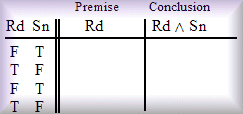
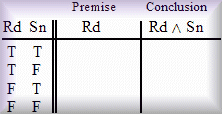
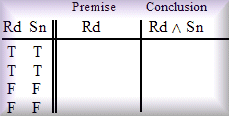
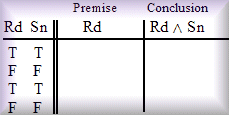
It's Rd Rd ^ Sn |
You can do it as a "quandry maze" to my right |
|
![]() |
![]() |
![]() |
Or as a homemade HTML maze starting below |

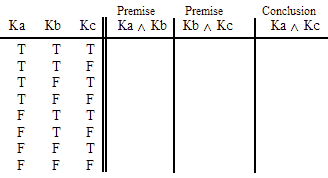
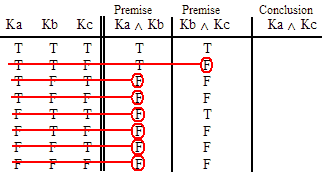
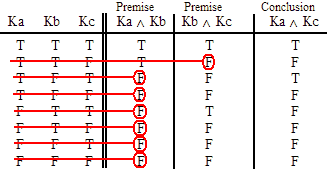
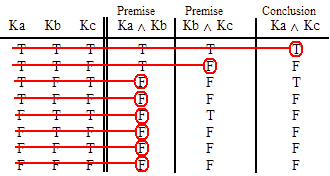
What about arguments with three terms, like Ka ^ Kb Kb ^ Kc ![]() Ka ^ Kc |
Well, it has a bigger truth table, for a start. |
![]() |
But why does it have eight rows? Hmmmmm? |
![]() |
![]() |
![]() |
![]() |
But you eliminate
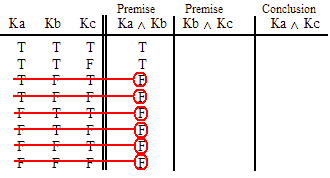
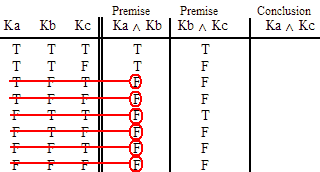
lines in exactly the same way: Cut F's under premises, and T's under the conclusion. |
![]() |
![]() |
![]() |
![]() |
![]() |
And guess what, it's VALID! (Cool huh?) |
![]() |
|
|
|
![]() |
![]() |
![]() |
![]() |
![]() |
![]() |
![]() |
Homework 4.
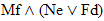
Use your own paper or the answer sheet at logic04homework.rtf. For each of the following arguments, prove it valid or invalid by truth
table.
|