If you've lost your textbook, or you would like a bit more help with these ideas, you can read Determinism Essay instead of or as well as the regular reading. You should read this study guide whatever else you do. If you stick with the regular texbook reading, please make absolutely sure you work though the following study guide as well.
Remember, you will be tested on the reading before the next lecture. Be ready to answer questions about these issues.
Before you start reading the text, I want to make at least one thing as clear as I can possibly make it. Determinism is NOT the opposite of free will. The frustrating thing about this unit is the fact that many people out there outside of philosophy (and some inside, who should know better) have taken the word "determinism" and added things to it. Specifically, some people have added to determinism the idea that free will doesn't exist. This is a truly bizarre thing to do, and it is not the way the word is used in science and philosophy, but many, many people do this. (It's very much like racial prejudice, sexism and homophobia, in which people assume all kinds of horrible things about other people merely because the other person is a different race, or female, or homosexual, or . . .) So I want to get one thing straight from the very beginning, the term "determinism" does not include the idea that free will is absent. If I say that an action was determined I am absolutely NOT saying that it was not free-willed.
To keep things clear, let me introduce the following terminiology:
Freewillism (a word I made up) is the doctrine that free will exists. It is the
doctrine that, whatever else is true, people at least sometimes act
on their own free will.
Nofreewillism (another word I made up) is the doctrine that free will does not
exist. It is the doctrine that, whatever else is true, people at never act on their own free will.
Another huge problem is that some students routinely confuse determinism with thgings like programming, predetermination, self-preknowledge, predictability, and robotism. If you properly understand determinism, you will know the following things:
Remember these points, because they will be on the quiz!
If you don't understand this, or you don't see why determinism isn't lack of free will, or programming, or predetermination, or predestination, or predictability, or knowing everything about yourself, or not being able to change your mind, go off and read Determinism Isn't, and come back when you do understand determinism properly.
Finally, I think it's important to remember that determinism is usually thought of as a condition that may or may not apply to specific systems. Thus determinism could be present or absent in a particular thing, like an automobile, a computer, or your brain, or particular parts of your brain, and it could possibly be present in some things and absent in other things, or present at some times and absent at other times. It's not always easy to tell if and when determinism is present in a system, because some systems are too complicated to predict. It's true that if an object is predictible, then determinism has to be present, since only deterministic objects can be predictible, but deterministic objects can also be unpredictible, so if something is unpredictable, that doesn't mean it's not deterministic. Cars, computers and healthy living brains are clearly deterministic, at least to some extent, because they are all predictible and controllable, at least to some extent.
We can also think about the idea that determinism applies to absolutely every existing object. I call this idea "general determinism," and it is false if even one object in one place is indeterministic. So general determinism would be false if indeterministic events happen in the hearts of supergiant stars, for instance. Of course, we know that determinism is not generally false, since a great deal of our universe is predictible and even controllable.
Here's a short quiz on determinism and free will.
If you are clear that determinism is not the denial of free will, and not predetermination and not any of those other things, go ahead and read pages 220-221, 223-225, 235-237 and 240 (in the 6th edition), or pages 211-212, 214-216, 226-228 and 231 in the 5th Edition, or pages 214-215, 217-219, 229-232 and 234 in the 4th Edition, or pages 214-219, 227-229 and 230 in the 3rd Edition
Study Questions For Pages 220-221 (6th edition), 211-212 (5th Edition), 214-215 (4th Edition), or 214-216 (3rd Edition)
There is an important problem with Laplace's view that Palmer does not mention. No measurement whatsoever can ever been made with absolute precision, and a small difference today can make a slightly larger difference tomorrow. You can never know absolutely everything about any particular situation. So, even if that situation develops completely deterministically, any prediction you make about how it will develop is likely to be invalidated by some small, but unavoidable error in your description of the situation. The more complicated the situation, the more small errors there will be, and the faster your prediction will be invalidated. Even in a simple situation, our inability to make any measurement with absolute precision means that there will be numerous small errors in any description of that situation. Some errors will cancel each other out, but statistically, there will always be some that add up, and these will sooner or later invalidate any prediction.
The fact is, LaPlace's thought experiment about this demon tells us absolutely nothing about what we actually can and cannot do. The universe is so vastly complicated that we could never know enough to predict more than a tiny, tiny, tiny fraction of future events, which means that his demon, although intriguing, is physically impossible.
Determinism and predictability are related, but that relationship is complicated. We have seen that deterministic systems are often so complicated that we can not predict very much about their future behavior. Another important thing to remember from this is that only deterministic systems are predictible at all. If a system is not deterministic, it cannot possibly be predictible. From this four closely related things logically follow:
Knowing that a system is deterministic does not mean that its behavior is predictable, but knowing that a system is predictable does mean that it is deterministic. (Remember this, because this question will be on the quiz!)
Some deterministic systems are a mixture of predictible and unpredictible events, so seeing some unpredictibility in a system is not the same as seeing indeterminism. For instance, after the 1930's, lung cancer rates in the US rose rapidly, and no-one knew why. Certainly, no-one had predicted this event, but that does not mean it was uncaused. In fact, soon after cancer rates begun rising, people noticed that cigarette smoking had also, and previously, began to rise steeply. After some scientific work, it was established that cigarette smoking drastically increases the probability that one will get lung cancer. (Wikipedia) It is true that science has not figured out any way to determine exactly which heavy smokers will get lung cancer, and which ones won't, but this element of unpredictability does not imply any indeterminism. It could be, and almost certainly is the case that other factors, such as one's general health and fitness, the state of one's immune system, and the mix of other chemicals in one's system all jointly determine whether or not a particular heavy smoker will or will not contract lung cancer. Thus the fact that a situation is partly predictible and partly unpredictible does not mean that it is partly deterministic and partly indeterministic, since such situations can easily be completely deterministic.
Study Questions For Pages 221 (6th edition), 212 (5th Edition), 215 or (4th Edition), (You can skip this bit if you only have the 3rd Edition)
Here is some more terminology. Reading the next section may help you understand what the term "determinism" actually means, and how it may actually be related to free will.
Causal determinism (the kind of "determinism" that concerns us here) is the doctrine that events are not random with respect to the conditions that immediately precede them. This means that every event that ever happens in a deterministic system is precisely caused by the
ensemble of relevant conditions that immediately preceded it. A slightly
different ensemble of conditions may or may not produce a significantly
different event, but exactly the same conditions will always produce exactly the
same event. This potentially applies to every object and condition in the universe, even
humans. If you are a deterministic system, and if we could recreate exactly the same conditions that existed at eleven
o'clock yesterday morning you would do exactly the same thing that you did do at
eleven o'clock yesterday morning. If we were to recreate exactly the same conditions that existed just before the last time you ordered chocolate ice cream, you would order chocolate ice cream. (Of course, you wouldn't know you were orderining it again, because your memories would be exactly the same as they were just before the first time.) This is the kind of determinism assumed by science, and it is the only kind of determinism that we have reason to believe exists.
Indeterminism (or "randomness") is is nothing more or less than the simple denial of determinism. It is therefore the doctrine that events are random. Events that happen in indeterministic systems are not caused by the
ensemble of relevant conditions that immediately preceded them. In a system that is not deterministic, the exact same ensemble of conditions will not necessarily produce the same result. (In fact, a group of objects that are indeterministicly related to each other cannot really be called a "sysyem", because the concept of a system depends the objects being able to affect each other, and that requires at least some degree of determinism.) This also potentially applies to every object and condition in the universe, even
humans. If you are not a deterministic system, then being in the condition of being absolutely determinined to do something has absolutely nothing to do whith whether or not you go it. Even if you experience yourself as choosing to order ice cream, that isn't necessarily what you will do. In fact, if your brain isn't deterministic, there is virtually no chance that you will actually do any of the things you choose to do.
An indeterministic brain would consist of nothing but billions of neurons all firing at random. There would be no patterns, and the action of any neuron would have no relationship with the action of any other neuron. The events in this brain would be essentially the same as "white noise," or the "snow" pattern of a TV set that's not receiving a signal from any actual station. It's absolutely meaningless.
General determinism (usually just "determinism") is the doctrine that everything in the universe, not just our volitions, but everything, is determined. If general determinism is true, volitional determinism (defined below) will certainly be true and quantum indeterminiacy will be false. If quantum indeterminacy is true, general dterminism will be false. However, as will be noted, if general determinism is false, volitional determinism can easily still be true.
Coercion is a condition such that some person is being forced to do something against his will. It has nothing to do with whether or not a system is deterministic. Coercion is also the only condition that can remove free will from a physically capable human being. If an action was coerced, then it was not free. If an action was free, then it was not coerced. Coercion only exists when
there is an outside force controlling what someone does. A condition would only remove someone's free will if it created an outside force that overruled the volition-creating processes in that person's brain.
For instance, say that Pierre's internal state has determined that he will go to church today. Unfortunately, a group of ninja have decided to take him to a Kurosawa film festival, so they surround Pierre, menace him with their scary black katana, and force him to go to the festival and watch The Seven Samuari. Now in this case, Pierre's actions were not determined by his own internal processes, and so they were not free.
Determinism is Not Coercion
Coercion is an external force that prevents people from what they want to do. Volitional determinism is an internal condition that determines what people decide to do. It doesn't prevent anyone from doing anything. What it does do is allow a person's mental states to determine what he does. This is important because it is coercion that prevents people from acting on their own free will. Since the only alternative to a free-willed action is a coerced action, people who believe that determinism is incompatible with free will will have to show how an internal condition of determinism can reach outside of a person to create an external condition of coercion.
For the quiz, please make sure you know that determinism is absolutely not the same thing as coercion. (And this question absolutely will be on the quiz.)
Thinky Questions For Pages 220-221 (6th edition), 211-212 (5th Edition), 214-215 (4th Edition), or 214-216 (3rd Edition)
Do Not Read Page 222 (6th edition), page 213 (5th Edition), or page 216 (4th Edition), (Don't worry about this if you have the 3rd Edition)
On page 222 of the 6th edition of his book, Donald Palmer gives a truly weird definition of the word "indeterminism." This definition, in which "indeterminism" is bizarrely not defined as the absence of determinism, is also suspiciously similar to the definition of free will, which means that Palmer appears to be pretending that "indeterminism" (randomness) and "free will" (a person determining her own actions) are actaully the same thing. This conflation of randomeness with self-control is extremely confusing, and makes that page pretty much useless (as well as wrong) so I want you to simply not read that page at all. (In fact, Palmer's page 222 definition of "indeterminism" on page 222 is not only wrong, it actually also contradicts the definition that he himself gives on page 237 of the same text. As I don't think it's a good idea to give students contradictory definitions, and I think reading contradictory (and wrong) definitions will only confuse you to no good purpose, I really hope you will follow my advice and skip this page.
Study Questions For Page 223 (6th edition), 214 (5th Edition), or 217 (4th Edition), 217 (3rd Edition, & ignore Pierre)
Study Questions For Page 224 (6th edition), 215 (5th Edition), or 218 (4th Edition), or 218-219 (3rd Edition, & ignore Pierre)
Thinky Questions For Page 224 (6th edition), 215 (5th Edition), or 218 (4th Edition), or 218-219 (3rd Edition,)
Study Questions For Page 225 (6th edition), 216 (5th Edition), or 219 (4th Edition), or 219 (3rd Edition)
Thinky Questions For Page 225 (6th edition), 216 (5th Edition), or 219 (4th Edition), or 219 (3rd Edition)
Donald Palmer seems to write as if the term "determinism" means the same as "general determinism." That is, he writes as if the term "determinism" can only mean "absolutely everything is deterministic." This is dangerously misleading. It's true that the term "determinism" could possibly be applied to the whole of the universe, but it could also be applied to parts of the universe. So determinism could also be mostly true, in the sense that almost all of the universe is deterministic, but some is indeterministic, or determinism could even be mostly false, in the sense that almost all of the universe is indeterministic, but some is deterministic, as well as possibly being universally true or universally false. (It's unlikely to be universally false since, if it was, there would be no laws of nature, and no objects or people would exist.
At this point, I think it's a good idea to precisely set out all the possible versions and variations on the idea of indeterminism. Strictly speaking, there's only one "version" of indeterminism. Indeterminism exists when a particular object does not behave deterministically. That is, an object is indeterministic if it's present state does not determine it's immediately next state. (For instance, your volitional system would be indeterministic if you deciding to do something could not result in you doing that thing.)
Study Questions For Pages 235 (6th edition), 226 (5th Edition), 229-230 (4th Edition), or 227-228 (3rd Edition)
Remember, there's no reason to think that there's any indeterminism involved in whether or not a particular heavy smoker does or does not get lung cancer. Palmer has just pointed out that it's possible that parts of the universe are a mixture of determined and undetermined events. For instance, it might be the case that you getting married is a determined event (you choose to do it because you want companionship, and so on) but who you marry is an uncaused, undetermined, random event (which person you marry has nothing to do with who you like or who you want to be with).
In the following reading, it's important to remember that when Palmer writes "statistical," he really means "acausal," "indeterminate," and "random." In common usage, the term "statistical" refers to the outcomes of processes where the behavior or the composition of the system is incompletely known, and these are almost always deterministic systems. Palmer, however, is arguing against determinism, so when he uses the term "statistical," he has to be referring to the idea of a system that is at least partially random.
Study Questions For Pages 236 (6th edition), 227 (5th Edition), 230-231 (4th Edition), or 228 (3rd Edition)
Study Questions For Pages 237 (6th edition), 228 (5th Edition), 231-232 (4th Edition), or 229 (3rd Edition)
Questions concerning only the "three component" formula and the triangle diagram)
These questions concern only two sentences and one diagram.
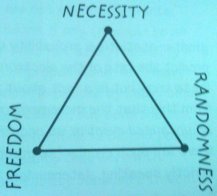
Immediately after showing clearly how lack of determinism would wipe out free will, Palmer immediately asserts that "freedom may very well be considered the opposite of necessity. Yet there are not just two components of this formula but three," and puts in a little diagram (see below) to illustrate this claim.
|
There are two senses of the word "necessity, " and I think that Palmer is confusing them with each other. There is "necessity" in the sense of determinism, and there is "necessity" in the sense of constraint. This is a vitally important distinction because where constraint clearly eliminates free will, it is not at all clear that determinism has any negative effect on freedom.
Consider Nescon and Nesdet. They are not related to each other, but by a strange coincidence, each of them finds herself pouring a saucepan full of lukewarm Bird's Custard. into a box of kittens, making those kittens sticky and unhappy. The difference between these two custardings is that Nescon poured in the custard because an unstoppable alien armada, equipped with unspeakably powerful weapons told her, quite truthfully, that they would destroy her, the whole rest of the planet, and several nearby planets, if she did not custard the kittens. Nesdet just did it because she has a mean sense of humor, and doesn't like kittens. In both cases the custarding was "necessary" in the sense of being determined, because in neither case was it a random (undetermined) act. But only in the case of Nescon was it a "necessary" act in the sense of being constrained. Because of the alien threat to destroy the world, she found it necessary to custard the kittens. In the case of Nesdet, who custarded the kittens because she wanted to, that action was only "necessary" in the sense of being determined. It was not "necessary" in the sense of being coerced, and so it was a free act, even though it was "necessary" in the sense of being determined. Thus, if we take "necessity" to strictly mean "determinism, " as Palmer does throughout our text, it is clear that "necessity" is not the opposite of freedom. And it seems to me that to assert that necessity is the opposite of freedom in this context is to swim perilously close to the fallacy of equivocation.
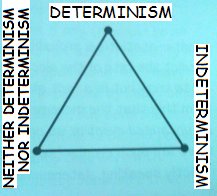
In addition to stating (falsely) that necessity (in the sense of "determinism") is the opposite of freedom, Palmer also says that "there are not just two components of this formula but three" and illustrates this claim with a little diagram of a triangle whose vertices are marked "necessity, " "randomness" and "freedom." Given that the diagram is supposed to indicate that our choices are not limited to determinism and the lack thereof, I have reproduced the diagram below, both in it's original wording, and (on the right) with the vertex titles translated into appropriate and unambiguous terms.
|
|
How did I come up with these translations? Well, Palmer is arguing for libertarianism and incompatibilism, he seems convinced that determinism rules out free will, he keeps referring to determinism as "necessity" and, as far as I can tell, never even uses the words "coercion" and "constraint, " so I have to assume that he means "necessity" in the sense of determinism. Besides, if he was taking "necessity" to mean "constraint" or "coercion, " he would not be arguing against soft determinism! So I'm pretty confident that "necessity" here means "determinism."
As for "randomness" meaning "indeterminism, " well, although there is a sense of "randomness" that means "unpredictability" instead of "indeterminism, " this diagram is about opposites, so while unpredictability is definitely not the opposite of determinism, "indeterminism"is just a word meaning "not determinism, " so I'm pretty confident here too.
But what does "freedom" mean in this diagram ? It can't mean "absence of constraint" here because absence of constraint is not the opposite of either determinism or indeterminism, and if Palmer defined "freedom" as "absence of constraint, " he would have absolutely no argument against soft determinism, so our only alternative here is to take "freedom" as the negation of both the other vertices of this diagram, which means that it stands for the combination of not determinism and not indeterminism. So in this diagram, the word "freedom" means "not determinism and not not determinism, " and that violates the Law of The Excluded Middle.
Study Questions For Pages 240 (6th edition), 231 (5th Edition), 234 (4th Edition), or 230 (3rd Edition)
Reading
Questions for the middle third of page 240 (The diagram and its
explanation)
What is
"responsibility?"
What is presupposed by
responsibility?
What two things are presupposed by freedom?
What
does "I can" mean?
What does "I could do
otherwise" mean?
According to Palmer, what part of the
diagram challenges compatibilism?
(Compatibilism is the doctrine
that determinism does not rule out free will.)
What analysis of
"could have done otherwise" do libertarians reject?
What
do libertarians say you also have to be free to do?
Thinky
Questions for the middle third of page 241 (The diagram and its
explanation)
Suppose the hypothetical conditional
analysis of "could have done otherwise" is just rendered as "I could have done otherwise, if I had wanted to"
instead of as "I could have done otherwise, if I had wanted to,
but I don't want to, so I can't do otherwise."
Do soft
determinists have any reason to add "but I don't want to"
to their analysis of "could have done otherwise?"
Do
soft determinists have any reason to add "so I can't do
otherwise" to their analysis of "could have done
otherwise?"
If someone is claiming that they have an
acceptable definition of "could do otherwise," would it
make sense for them to add "so I can't do otherwise"
to their definitition of "could have done otherwise?"
What about, "so I didn't do otherwise?"
instead of "so I can't do otherwise?" Wouldn't that work better here?
Libertarians say you have to be free to want other than you do.
Does determinism mean that, if you change
your mind, someone will appear and make you change it back?
Suppose
we rewrite the diagram in terms of "wanting" instead of
"doing," so the last box reads "I could want
otherwise?"
Suppose compatibilists interpret this as saying
"I could have wanted otherwise, if whatever it is that makes me
want things had turned out differently." Would there be any
logical problems with that?
When libertarians say that "I
could have done otherwise, if I had wanted to" is a bad rendition of "I could have done otherwise" what exactly do they therefore mean by "I could have done
otherwise?"
Wouldn't it be "I could have done otherwise, whether I had wanted to or not?"
Now I ask you,
what kind of sense does that make?
When libertarians say that
you should be free to want to do otherwise, do they prove
that soft determinists say that you're not free to
want otherwise?
Do they prove that determinism implies that someone will show up and force you to want something you don't
want?
If they do, how do they prove it? What argument do they
give?
Do they prove that determinism implies that you're
not free to want otherwise?
If they do, how do they prove it? What
argument do they give?
As a matter of fact, do you currently
perceive yourself as free to want other than you want?
Think of
your favorite food.
Imagine you go into your favorite restaurant
and, as you begin to order, you want your favorite food.
Now,
consider the following two scenarios:
Determinism implies
that, at the moment you begin to order, processes inside your brain,
based on your preferences, mood and so on, could cause you to change
your mind and, just then, you would want something else, and order
that. Suppose that this happens and, instead of your favorite food,
you order something else this time. Because this is a result of a
deterministic process, your new "want" is based on your own
existing knowledge, preferences and mood. It's not random, it comes
from you, who you are, what you like, and what you want. In this kind
of scenarion, your favorite is, say, fettucino alfredo, but you also
like lasagna, and this time you change your mind at the last second
and order lasagna.
Indeterminism implies that, at the moment
you begin to order, an event happens that has nothing to do with
processes inside your brain, nothing to do with your preferences,
nothing to do with your mood, nothing to do with anything about you,
could completely ignore your mind and, just then, you would want
something else, and order that. Suppose that this happens and,
instead of your favorite food, you order something else, something you'd never want, this time.
Because this is a result of an indeterministic process, your new
"want" is not based on your own existing
knowledge, preferences or mood. It's random, it has nothing
to do with you, it has nothing to do with who you are, it has nothing
to do with what you like, and it has nothing to do with what you
want. In this kind of scenario, your favorite is, say, fettucino
alfredo, but you also like lasagna, and this time something that
isn't you changes your mind at the last second and order fifteen
unripe bananas tied together with spinach and drenched with bacon
grease. If you don't like that, it doesn't matter, because being
indeterministic means that this has nothing whatsoever to do
with what you like or dislike.
Now I ask you, which
scenario sounds like your own life? The deterministic one in which
you occasionally change your mind to new choices that still make
sense based on your own preferences, or the indeteriministic one in
which you randomly change your mind to new choices that have nothing
to do with your own preferences?
Make sure you can answer all of these basic questions correctly. Answers to these questions are provided at the bottom of this page.
How To Make Up Quizzes
If for some reason, (illness, family emergency, conflicting academic obligation, sudden discovery that you have superpowers coupled with the need to save the Earth from a hurtling asteroid that only you can deflect), you miss one of my delightful quizzes, you can make up the lost points by writing up a clear, precise, and deeply insightful answer to one of the potential exam questions and turning the results in as "make-up quiz." Illustrations are not absolutely necessary, but would add a nice touch.
Potential questions for Quiz For these questions, check your answers against the text and reading above.)
Potential Exam Questions
Explain and analyze the precise relationship between determinism and such concepts as randomness, programming, predetermination, predestination and coercion. Explain determinism in your own words, and say how it is logically related (or unrelated) to these other concepts,
Explain and analyze the precise relationship between determinism and predictability.
Explain materialist determinism in your own words. Explain LaPlace's "Demon," and what the demon is supposed to be able to do. Explain the difference between practical, and "in principle" predictability. Using your own examples, explain the relationships between these concepts as clearly and precisely as you can. Does determinism imply predictability? Does unpredictibility imply indeterminism? Does indeterminism imply unpredictability? Does predictibility imply determinism? Explain all your answers as clearly and completely as you can.
Critically analyze Palmer's "could do otherwise" argument about the beliefs of the ordinary person-inn-the-street. What two things does Palmer claim about the beliefs of ordinary people? Does the ordinary person-in-the-street actually believe that her actions are undetermined? What is she more likely to believe about her actions? What is the Humean version of "could have done otherwise?" What is the Palmeran version of "could have done otherwise?" Which version really best fits the beliefs of the ordinary person-in-the-street, and why?
Explain and analyze B. F. Skinner's argument against free will.
Explain the difference between the causal model and the teleological model of human behavior. How is the difference between these models relevant to the existence of free will? How is that difference relevant to the existence of personal responsibility? What would be the social impact of accepting Skinner's theory? What assumption does Skinner share with Donald Palmer? What is wrong with that assumption, and how does this failure undermine Skinner's theory?
Compare and contrast B. F. Skinner's argument against free will with Palmer's "could do otherwise" argument against determinism. What assumptions are shared by both arguments? What does Skinner believe that Palmer doesn't? What does Palmer assume that Skinner doesn't? In the disagreement between Skinner and Campbell, what side is best supported by the available evidence? If we assume that Cambell and Skinner are both right in the assumption that they share, which conclusion about free will is best supported by the evidence?
Explain the "uncertainty principle"
argument against libertarianism, and evaluate Palmer's reply to that argument.
What did Heisenberg claim about subatomic reality? What implications does this have for the relationship between indeterminism and free will? Why would this relationship seem to prove that libertarianism cannot be true? What is Palmer's "three components" answer to this argument? Define all three components of this formula clearly and unambiguously. Does the three component formula actually save libertarianism fro the Heiesenberg problem? Explain why or why not.
Explain and critque Young's claim that libertarianism actually contradicts itself. Describe and analyze Donald Palmer's "Necessity, Randomness, Freedom" response to the fact that lack of determinism rules out free will. What is "necessity" in this model? What is "randomness" in this model? What is "freedom" in this model? If we interpret this model as referring to the presence and absence of determinism, what logical rule(s) does this model violate? Why does Young think this model fails to save libertarianism from the indeterminism problem? Give the most precise definitions of free will and determinism, and explain what the correct definition of free will implies about determinism. Explain exactly why Young thinks libertarianism contradicts itself, and say whatever you can about the strength or weakness of Young's reasoning.
Any exam answer can be enhanced by addition of any comments that occur to you. The more you think about a topic, the more likely you are to come up with something that can earn you a little more credit for your answer. I never deduct points, so it can't hurt to add your own thoughts.
Answers to review questions:
Copyright © 2013 by Martin C. Young